Fiber Art, Tutorials

Demystifying Stamp Pads

 I’ve been using Ink Stamp Pads forever. Remember as kids when you’d get hold of an old stamp and stamp pad and brand everything in sight including the back of your hands?

Many years later I tackled scrap-booking then journaling – again making use of those tempting rubber stamps and lovely inky pads. In those days it was pretty straightforward. If the color called my name I used the pad and didn’t care if it was Dye Ink, Pigment Ink, Solvent, Archival, or whatever.

Now with art quilting there’s more to the selection and more risk in selecting the wrong type of pad. It’s got to transfer cleanly to a very porous surface. And of course you don’t want fading.

You may also be concerned about the image staying put AND crisp and clear after washing or if you’re planning to use wet media over the image. I have NOT included the effects of washing on these samples and will do something on that another time.

Oh I got so confused!!!  Everywhere you look – known and trusted online sites/blogs, manufacturers’ sites or craft shop advice sites you get someone else’s opinion. And often these opinions are at odds with one another.

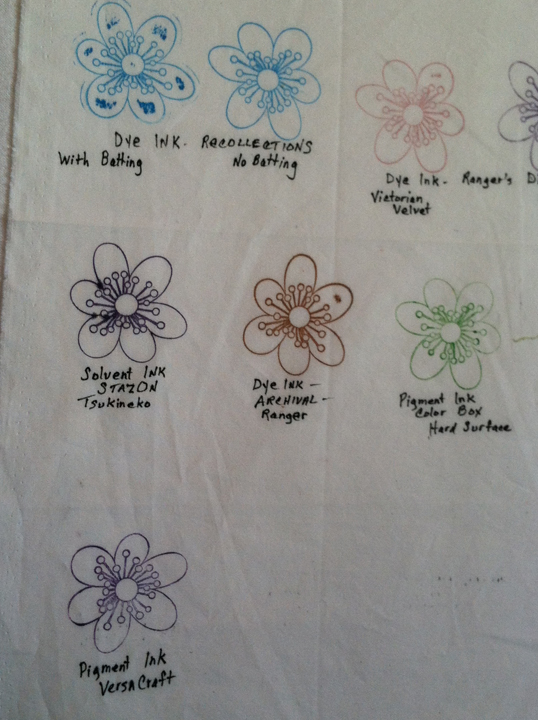
So I decided to take matters into my own hands and go back into my mad scientist mode. I lined up ALL the different types of ink stamp pads that I had on hand, chose a rubber stamp that would print well (not too much detail and deeply carved stamp ridges) on fabric and went to work.

1. I washed, dried and pressed the fabric first: some bleached muslin. (you’ll get a slightly different color cast using the unbleached.)

2. One by one I inked up the stamps, stamped the fabric, and recorded what was used.

3. In a couple of instances I also documented the Surface that I stamped on to see if that made a significant difference. For instance whether it was a hard surface or a cushiony one – including batting.

4. After making sure all impressions were completely dry I pressed with a hot iron.

NOTE: Because I’m going to be using these in Art Quilts I did not wash the fabric again after stamping it. So this is NOT a test for washability, simply a comparison of how well the inks did visually on the fabric. I was looking for vibrancy, clarity and crisp edges.

Here are the photos of my first go-round.
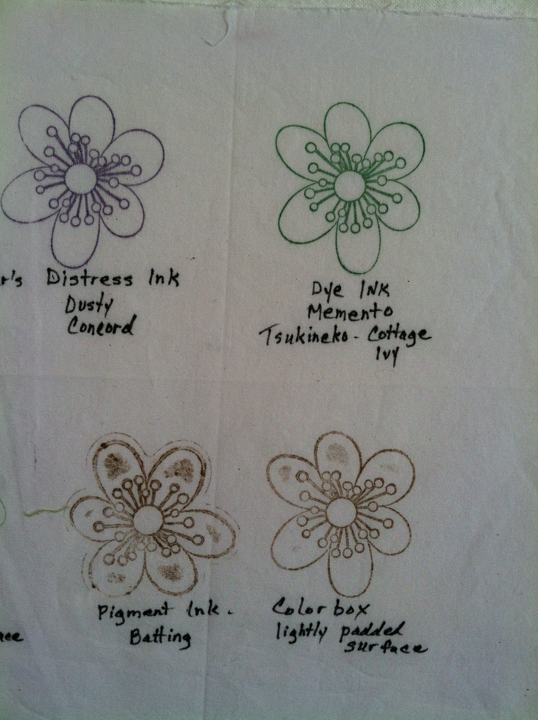


                  In my opinion the best performers were the dye inks from the Recollections and Memento (Tsukineko) lines. I stamped with Recollections with and without batting under the muslin and definitely got a crisper edge without the batting.

I also was pleased with the Dye Ink in the Distress Ink Line from Ranger. (That’s the one in the group to the LEFT in the upper left hand corner.)

The solvent ink from Staz-on and Archival Dye Ink from Ranger were both excellent. The downside with both is that they are limited in color choice and are quite pricey.

The pigment ink from Colorbox left a smudgy outline. I tried it on a lightly padded surface, over batting and on a hard surface. The hard surface was best but still not as distinct as the Dye Inks.

The pigment ink from Versacraft was acceptable but not as crisp as Memento.

*A note about Versacraft: it is widely accepted as a good choice for fabric stamping as it has proven to stay put after washing. So if that’s your need it’s definitely a consideration.

Further test:

I further tested the Dye Ink from Recollections with a larger stamp to see if I could repeat the good outcome. I am partial to this particular pad because of availability and lower cost. However I haven’t seen it in a wide array of colors.

I retested the Memento as well. Both were excellent. Memento has a broad choice of colors available. It’s a little pricey in the larger stamp pad but is available in a smaller more economical Dew Drop size.

And here is the Dye Ink from Ranger (Distress Ink) This comes in a wonderful array of colors.

Next I will be testing my collection of brush markers with stamps to see how they perform on fabric so stay tuned.

Please pretty please leave me a comment – especially if you have had experience with any of these and would like to add your observations. That would be grand and thank you!!

Art Quilt, Fiber Art, Workshops

A Blossoming of New Quilt Artists

Monday evening arrived and we gathered around the classroom tables at Baron’s Sewing Center in Woodland Hills. We were all there for an eagerly awaited kickoff to a series of workshops in Art Quilting. (The next workshops – a series of 3 – begins Wednesday April 25th 10 AM until 1 PM for 3 weeks)

My co-conspirator (Betsy Farwell) and I had all our props lined up and plenty of information to share with this budding group of quilt artists.

Several of the assembled had never been involved in art quilting at all. Our goal was to introduce them to some of the basic concepts and techniques of art quilting. Traditional quilting is filled with ‘rules’ and exact measurements. Art quilting is all about creativity and throwing away the rulebook.

Several participants were a little anxious because they didn’t consider themselves to be “artists”. We aimed to get across the idea that there are many ways to be an artist – that being able to draw well is a great skill to have but it is only one of many. The first prerequisite to being an art quilter is a willingness to experiment and to let your creative mode loose. It is not even necessary to have quilting experience. Many art quilters came to the field from general art backgrounds; some jumped immediately to art quilting after just a brief intro to quilting.

Our major task was to decide which of the many techniques of dozens and dozens to highlight and to demonstrate. We ended up with a smattering of surface design techniques such as fabric painting with Shiva paintstiks and Acrylic paint and use of rubbing plates, stencils and stamps. We also introduced the group to various methods of fabric discharge.

To add a little glitz and glamor we demonstrated use of foil and Angelina embellishment. We had available a potpourri of fun tidbits that they could use as they wished on their creations.

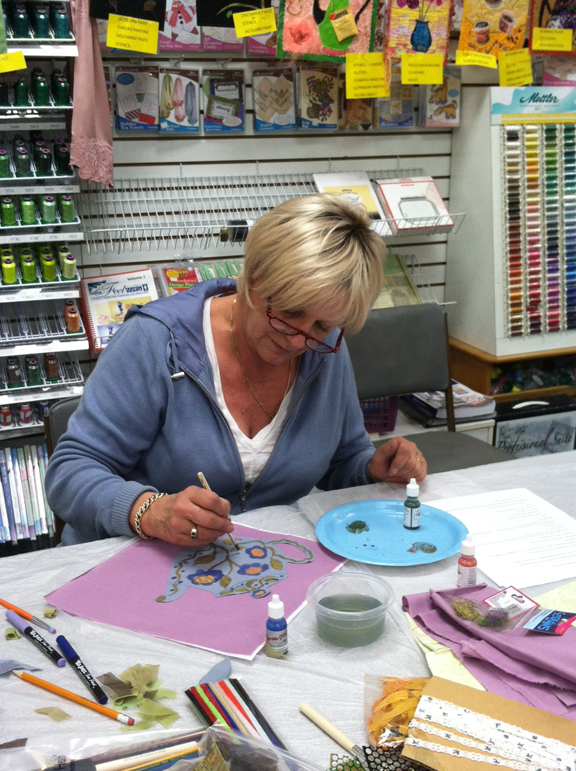
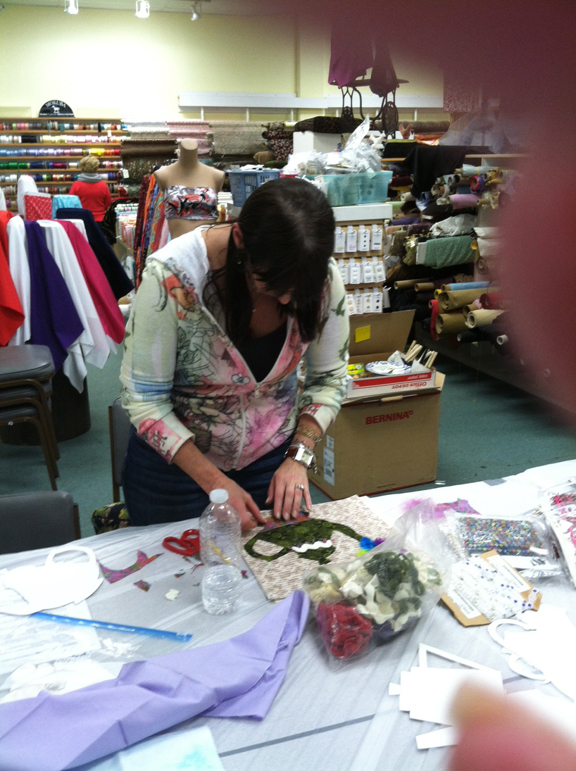
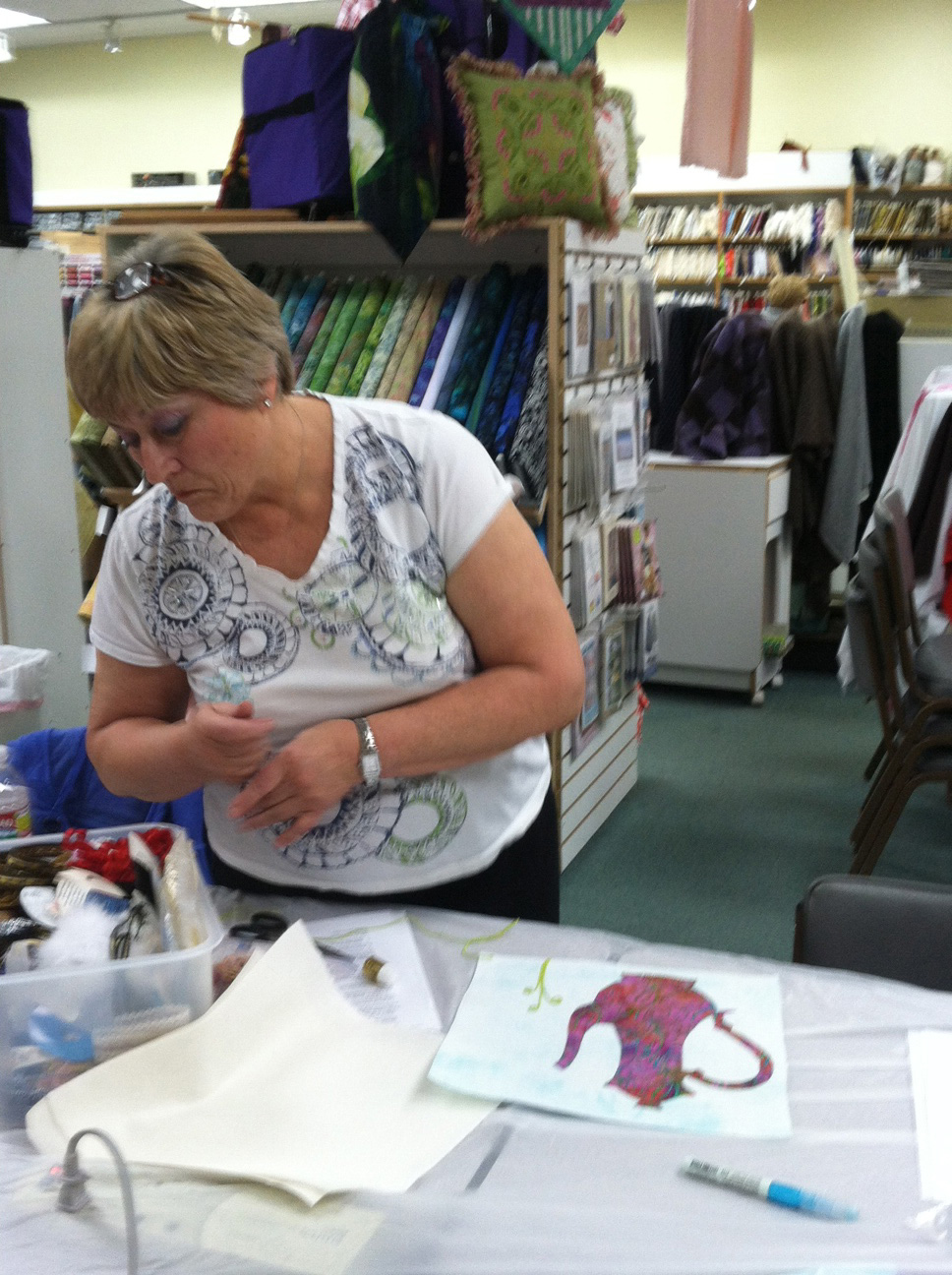
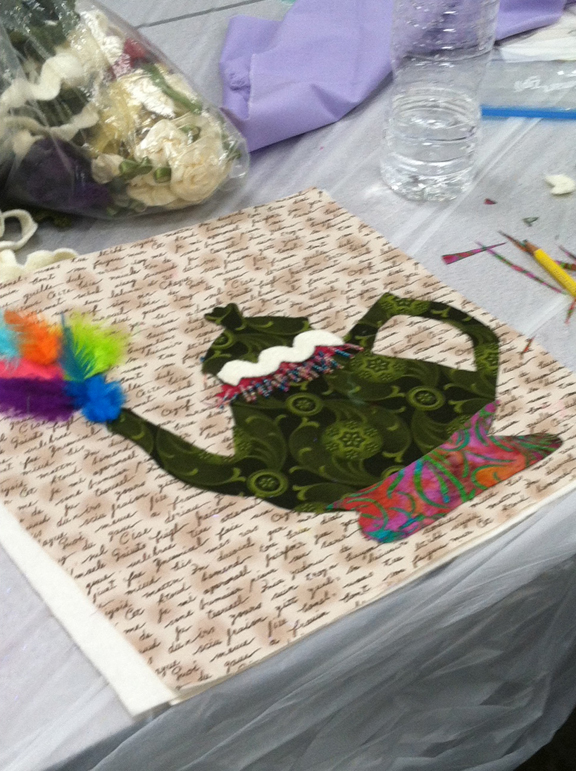
There was limited time for the group to play and try out all these techniques. But we turned them loose and play they did! To save time we provided some of our own teapot patterns. It was so much fun to see the group go off in their own directions to create their unique quilts. And here is some of their work in progress.


Art, Haiku, Mixed Media, Poetry, Poetry and Photography

Phases of the Moon

The prompt word for February’s Haiku Art Challenge was “Moon.”  I thought of all the different sayings that we have to describe the moon: some quite descriptive, others turned into common expressions and a few quite fanciful.  So much folklore and romance has evolved from our common experience of viewing this orb in the night sky. called

  Blue Moon, Green Cheese Moon and Harvest Moon
Chameleon moon
many faces to delight
changing yet constant
Phases of the Moon
Phases of the Moon
 
Life

Thursday Delights

Writing this on my status update last night felt very good and really brought the whole day into focus.  I’ll bet that if you stop and think for just a moment, that you can come up with a similar list for your day.  Even if lousy stuff happened – think of the moments that made your day special.  Our lives are made up of many thousands of moments like these.  Savor each one.

Today was a regular day but one of those days when everything just feels good. And here are some of reasons why. As I said, nothing out of the ordinary, just being aware and savoring each moment.

Thursday Delights

wearing brightly patterned socks
granola and yogurt with blueberries
browsing the art supplies in my favorite store
the sun’s gentle benediction
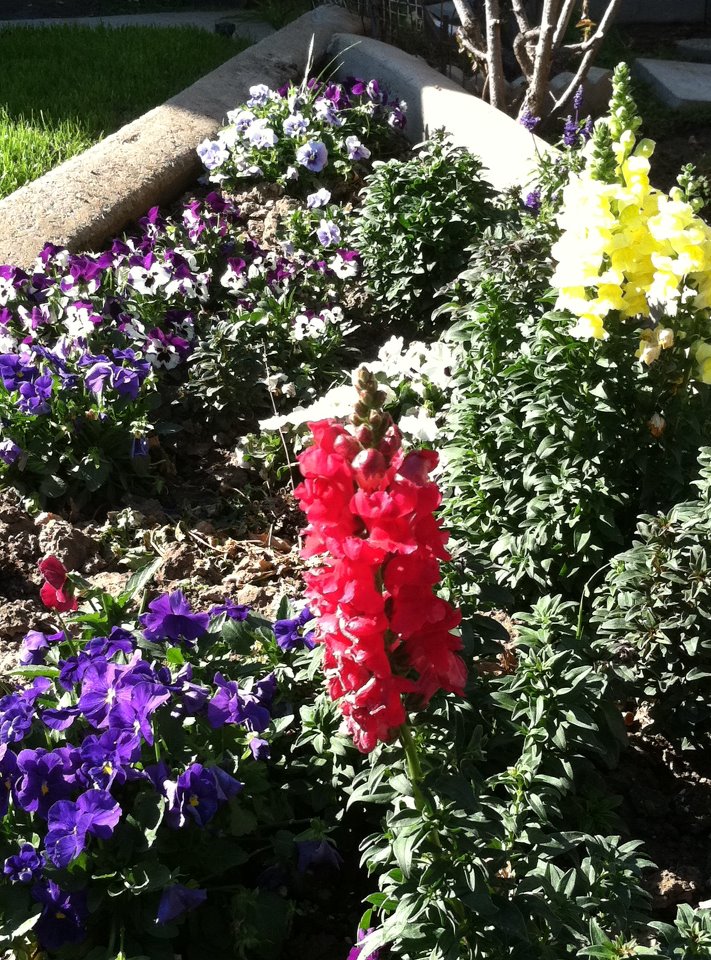
a visual feast of pansies and snapdragons
mixing colors in art class
finding a missing pattern book
filling a donation bag for pickup tomorrow
agreeing to raid the ‘frig for dinner
music in the car; music in the studio
talking to friends and family
giving and receiving warmth and caring.

Visual feast of 'dragons and pansies

Life

The Blue Orchard: A Novel by Jackson Taylor – my first book review on Goodreads

The Blue Orchard: A Novel

The Blue Orchard: A Novel by Jackson Taylor

My rating: 5 of 5 stars

Set in the 50’s in and around Harrisburg, PA. This very well written book tells a good story and at the same time raises many questions about hotly debated topics in the news today. The protagonists are involved in providing what was at the time illegal abortions. Various aspects of the whole abortion issue are raised in the context of the story and can lead to some great discussion. A lot of the action also focuses on the political machine in power – again leading to inevitable comparisons with contemporary U.S. politics. The issues of racism and women’s roles are also explored.
The story begins in the midst of the Depression years and we get a glimmer of what life must have been like as we accompany the main characters in their struggle.
Very good characterizations are a hallmark of this book. All in all a great story and I highly recommend it.

View all my reviews

Art Quilt

An SOS to My Art Quilting Readers – Need Ideas

Please excuse if you see this more than once.  I’ve cross posted it to the Quilt Art list and on my Facebook page as well.

I have a logistics/design issue that I’ve been working on and am not happy with my solutions so far.
I’m SURE there must be one or more of you out there who has happily solved this.

I have more than a dozen small quilts that vary in size with the largest about 12 x 12.
They do not have a cohesive theme of any kind.
I would like to put them all into book form for viewing – but want it to be fairly easy to remove them and of course not damage them in any way.  I do not want to put them into ‘jackets’.

I have looked at several tutorials and patterns and everything I see is related to making a cover for an existing journal or sewing/quilting a journal.  Some of these are extraordinarily beautiful but not what I need.
Ideas???

Thank you!!

Art Quilt, Fiber Art

Quilt in Progress – time for some Fiber Art

Well, this is primarily a visual arts blog so I’d better do a quick entry and bring you up to date with what’s on my wall.  The nice thing about having so many pieces in progress is that I have a variety of styles to work on and will never ever get bored. The bad thing about having so many pieces unfinished is having so many pieces unfinished.

I started this awhile back and am in the midst of quilting it. Almost there!  I based it on the Hollow Box block by Sara Nephew then designed the overall quilt.  Not sure if this would qualify as an art quilt. I’d probably call it a contemporary quilt if pressed to pigeonhole it.

What would you call it?

Life, Music, Social Commentary

Celebrity Deaths and Public Reaction – from Larry Lootsen’s Blog

A very interesting article from Larry Lootsen’s blog

larrylootsteen's avatarLarry Lootsteen's Blog

I have asked myself this question before but I’ve never really written about it. I thought this deserved a look.

With the recent death of Whitney Houston I was struck by what amounts to a truly insane reaction. People who never met her or got to see her perform weeping like their own mother died. You can flame me for this but it annoys me. A lot.

Whitney Houston was a great talent. But I definitely don’t lump her in the same category as Elvis, John Lennon or Michael Jackson. She burned bright and burned out. She hasn’t done anything of note in years. Being dead doesn’t make you a legend. It isn’t even a requirement.

So I started asking myself, as a U2 fan, how would I react if Bono died?

Would I cry? Would I run out and find a vigil to attend? Would I start my own…

View original post 511 more words

Life

C is for Coincidence………Why I’m a Skeptic

C is for Coincidence ………….Why I’m a Skeptic

Do you sometimes wonder if an occurrence was a coincidence or……if other forces were at
work? A friend and I were discussing this the other day and I told her a story about something that happened to me a while back.

I’ll change a couple of names here – for the privacy of the individuals. But the rest of this tale is absolutely 100 % true.

One of my classes in grad school was The Nature of Stress and Health. For our term paper I had decided on the topic “The Relationship Between Stress and Cancer”. My classmate and colleague Valerie and I headed over to the Cal State Northridge library after work to hit the stacks and hopefully to make some progress on our research.

Valerie and I both worked in Nursing Administration at a local hospital; I was the Director of In-service Education and was pursuing my Master’s evenings and weekends.

We spent close to three hours going through piles of books and journals. I was looking for scientific studies that pertained to my subject matter of stress and cancer; they were scarce but I did find several anecdotal reports that were fascinating. And you know how it goes when you start doing research; one article leads you to another and yet another: something like web cruising actually.

So I copied up the few that looked promising but was frustrated by not being able to locate more. There were two that I was especially disappointed not to find. They had been referred to in yet another publication as a source and had been written by a psychologist named Arthur Barnwell. One referenced a paper he had written; another referenced “personal communication.”

So Val and I packed up for the evening and went to our homes to continue our reading.

The next morning I was back at my desk by 8:30 and got busy organizing a full day of nurse orientation and specialty training classes.

At just after 9 AM my phone rang – the caller said: Hello Mrs. Greer, my name is Dr. Arthur Barnwell. I coach medical personnel in stress reduction techniques and would like to talk to you about setting up a session for your staff there at the hospital.

After I regained consciousness I responded: I’d be happy to talk to you further about that Dr. Barnwell. But first I have a request for you. You know that article that you wrote about Stress and Cancer 2 years ago? Where can I find a copy of it? Then I went on to explain what had happened the previous evening.

We finished our conversation and I immediately ran into Valerie’s office jumping up and down and screaming at the top of my voice: “You won’t believe who just called, you won’t believe this!!!”

Epilogue: I got my articles directly from the author a couple of days later in the mail. And the following month our nursing staff got some hints as to how they could lower their day to day stress level at work. Oh, and I got an A in the class!

I’m still reluctant to call what happened a simple coincidence. What do you think?